
Choosing the right water pipe material is essential for any building, infrastructure, or plumbing project. The type of pipe you use directly affects water pressure, durability, maintenance cost, and long-term performance.
From residential plumbing systems to large municipal water supply networks, different pipe materials serve different purposes. Understanding the differences can help contractors, engineers, developers, and homeowners make better decisions.
In this guide, we explain the most common types of water pipes used in building and infrastructure projects, their applications, advantages, and limitations.
Understanding Water Supply Pipes vs Drainage Pipes
Before selecting pipe materials, it is important to understand the difference between:
1. Water Supply Pipes
Water supply pipes deliver clean and pressurised potable water into buildings.
Common applications:
- Kitchen water supply
- Bathroom plumbing
- Water tanks
- External pipeline connections
2. Drainage Pipes
Drainage pipes remove wastewater from buildings through gravity flow.
Common applications:
- Sewer systems
- Wastewater discharge
- Rainwater drainage
Choosing the wrong pipe material for either system can lead to leaks, pressure failure, and costly repairs.
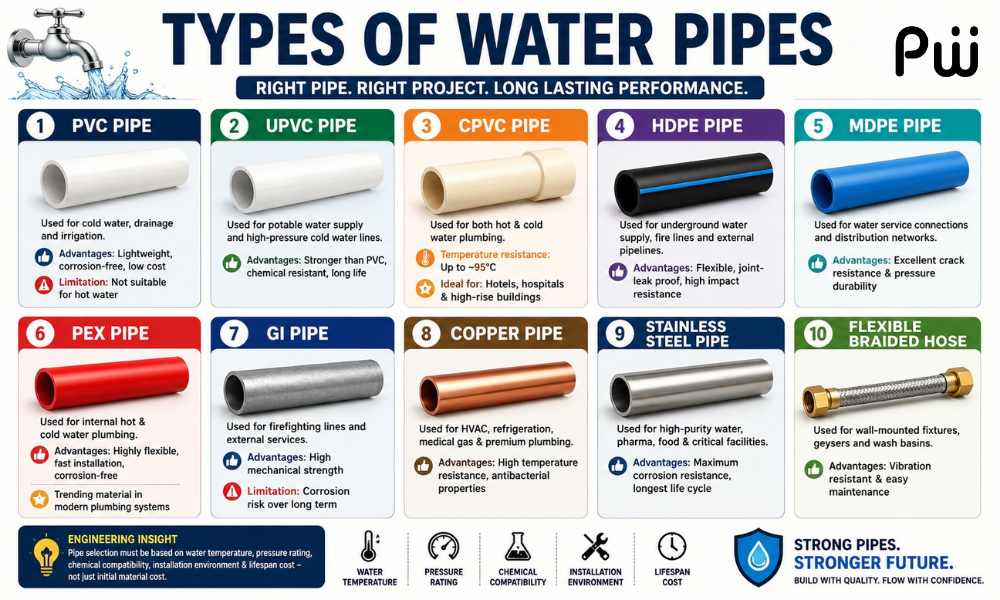
1. PEX Pipes: Modern Flexible Plumbing Solution
PEX (Cross-linked Polyethylene) has become one of the most popular choices for residential plumbing.
Unlike rigid pipes, PEX is highly flexible, allowing installers to bend it around corners without using multiple fittings.
Advantages of PEX Pipes:
- Flexible and easy to install
- Faster installation
- Lower labour cost
- Fewer joints, lower leakage risk
- Good freeze resistance
Best Use for PEX:
- Indoor hot and cold water supply
- Residential plumbing
- Bathroom piping
- Kitchen water systems
In Summary:
PEX offers lower installation costs, while copper provides longer proven durability. If speed and cost matter, PEX is often the preferred option.
2. Copper Pipes: Reliable and Long-Lasting
Copper pipes remain one of the most trusted plumbing materials worldwide. Known for durability and high-temperature resistance, copper is widely used in premium plumbing systems.
Advantages of Copper Pipes:
- Long lifespan (50+ years)
- High heat resistance
- Strong and durable
- Naturally antibacterial
- Safe for potable water
Best Use for Copper Pipes:
- Hot water systems
- HVAC systems
- Medical gas systems
- Premium residential plumbing
In Summary:
The main disadvantage is higher material and installation cost.
3. PVC Pipes: Cost-Effective for Cold Water Systems
PVC (Polyvinyl Chloride) is one of the most commonly used plastic pipe materials. It is lightweight, affordable, and corrosion-resistant.
Advantages of PVC Pipes:
- Low cost
- Easy installation
- Lightweight
- Corrosion resistant
Limitations of PVC Pipes:
- Not suitable for hot water
- Can deform under high temperature
Best Use for PVC Pipes:
- Cold water supply
- Drainage systems
- Irrigation systems
In Summary:
PVC remains one of the best options for non-heated water systems.
4. CPVC Pipes: Better for Hot Water Systems
CPVC (Chlorinated Polyvinyl Chloride) is an upgraded version of PVC designed for higher temperatures. Unlike PVC, CPVC can safely carry hot water.
Advantages of CPVC Pipes:
- Suitable for hot and cold water
- Better heat resistance
- Chemical resistant
- Strong and durable
Temperature Resistance:
- PVC: up to 60°C
- CPVC: up to 95°C
Best Use for CPVC Pipes:
- Hotels
- Hospitals
- Commercial buildings
- High-rise plumbing systems
5. HDPE Pipes: Best for Infrastructure and Underground Water Supply
HDPE (High-Density Polyethylene) pipes are widely used in infrastructure projects because of their flexibility, durability, and leak-proof jointing system. Unlike traditional rigid pipes, HDPE pipes can handle ground movement and pressure changes.
Advantages of HDPE Pipes:
- Flexible and impact-resistant
- Leak-free fusion joints
- Corrosion resistant
- Long lifespan (50+ years)
- Suitable for underground installation
Best Use for HDPE Pipes:
- Municipal water supply
- Underground water pipelines
- Fire protection systems
- Irrigation systems
- Industrial pipelines
In Summary:
HDPE piping systems are widely used because of their long-term reliability and strong performance under demanding site conditions.
6. Ductile Iron Pipes: Heavy-Duty Municipal Solutions
Ductile iron pipes are commonly used for municipal water distribution systems. They provide high strength and excellent pressure resistance.
Advantages of Ductile Iron Pipes:
- High mechanical strength
- Suitable for high-pressure systems
- Durable for underground use
Limitations of Ductile Iron Pipes:
- Heavy installation
- Higher transport cost
In Summary:
Ductile iron remains a trusted solution for city water infrastructure.
7. Galvanised Iron Pipes: Traditional but Aging
Galvanised iron (GI) pipes were once widely used in buildings. They have strong mechanical properties but face corrosion issues over time.
Common Problems:
- Internal rust buildup
- Reduced water pressure
- Brown water issues
In Summary:
GI pipes are now less common in modern plumbing systems.
How to Choose the Right Water Pipe Material
Choosing the right pipe depends on:
1. Water Temperature
Hot water systems need CPVC, Copper, or PEX.
2. Pressure Requirements
High-pressure systems may require HDPE or ductile iron.
3. Installation Environment
Underground installations benefit from HDPE flexibility.
4. Water Quality
Some materials perform better under certain water chemistry.
5. Lifecycle Cost
Consider maintenance, repairs, and replacement costs—not just purchase price.
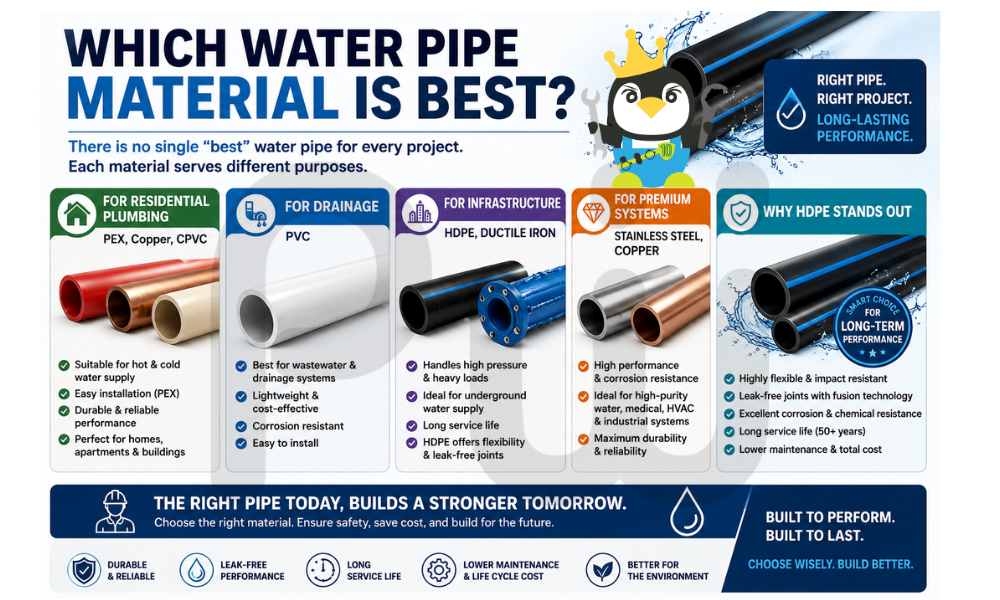
Which Water Pipe Material is Best?
There is no single “best” water pipe for every project.
Each material serves different purposes:
- For residential plumbing: PEX, Copper, CPVC
- For drainage: PVC
- For infrastructure: HDPE, Ductile Iron
- For premium systems: Stainless Steel, Copper
For long-term infrastructure performance, HDPE remains one of the most preferred choices because of its flexibility, leak-free joints, and long service life.
Connect with Polyware
With over 30 years of experience in Malaysia, Polyware is a trusted manufacturer specialising in high-quality HDPE pipe fittings and complete piping system solutions.
As a one-stop pipeline solution provider, we offer:
- Over 1,000 types of PE pipe fittings
- Tailor-made solutions for project-specific requirements
- In-house mould making (OEM available)
- Professional technical consultation support
- Industry training and knowledge sharing
Our house brands, PENGUIN (mechanical/compression fittings) and POLYFUSE (electrofusion solutions, butt fusion solutions, socket fusion solutions), are designed to deliver reliable, long-term performance across water supply, biogas, cable ducting, mining, irrigation, aquaculture and industrial applications.
Interested in our products or solutions? Our team is ready to assist you.
- Website: https://polyware.com.my/
- Email: [email protected]
- Oversea Support: +6012-9128237
- Domestic Support (Semenyih): +6012-5069281
- Domestic Support (Kuching): +6010-2394134
We aim to respond to all enquiries within 24 hours. For urgent assistance, feel free to contact us directly.