
Pipe fitting installation mistakes are one of the biggest causes of leaks, pressure loss, and costly repairs in plumbing and HDPE piping systems. While installing pipe fittings may seem simple, small installation errors can lead to major system failures over time.
Whether you are installing HDPE pipe fittings for irrigation, water supply, agriculture, or industrial use, the connection point is often the most critical part of the system.
The reality is this: most pipeline failures do not start from the pipe itself — they start at the fitting.
Understanding the most common pipe fitting installation mistakes can help you prevent leaks, reduce maintenance costs, and improve system reliability.
In this guide, we will highlight the most common mistakes people make when installing pipe fittings and share practical tips to help you achieve a stronger, safer, and longer-lasting connection.
Why Proper Pipe Fitting Installation Matters
A pipe fitting is more than just a connector. It is the point where pressure, water flow, and sealing performance come together.
When fittings are installed correctly, they create a secure, leak-free connection that supports long-term performance. But when installed incorrectly, even a small mistake can result in:
- Water leakage
- Pressure loss
- Pipe damage
- System failure
- Higher repair costs
For systems such as irrigation pipelines, water distribution networks, and HDPE piping systems, proper fitting installation is essential to maintain efficiency and durability.
3 Common Pipe Fitting Installation Mistakes
Many pipe fitting problems are preventable. Here are the three most common mistakes installers make.
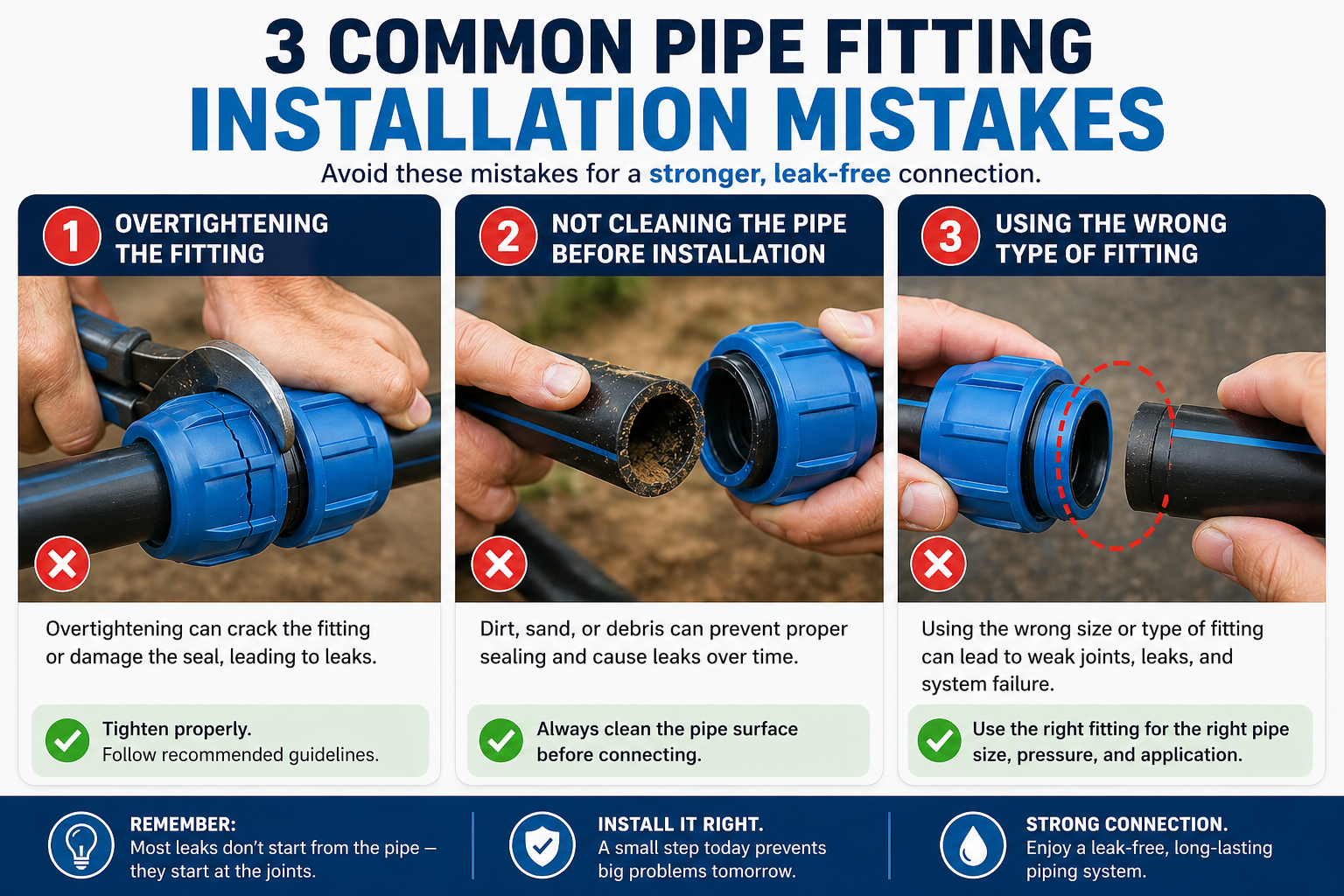
1. Over-Tightening the Fitting
Many people assume tighter means better. In reality, overtightening can damage the fitting body, deform the sealing components, or crack the connection area.
This often leads to leaks. sometimes immediately, sometimes after months of use.
Why overtightening is a problem:
- Damages threads and sealing surfaces
- Increases stress on the fitting body
- Reduces fitting lifespan
- Causes leakage under pressure
How to avoid it:
- Tighten according to manufacturer guidelines
- Avoid excessive force
- Ensure the pipe is fully inserted before tightening
Tip: Tight is good. Too tight is trouble.
2. Skipping Cleaning Before Installation
Many leaks start because the pipe or fitting was dirty during installation. Dust, sand, mud, or small debris can prevent the sealing ring from making full contact with the pipe surface. Even a small particle trapped inside the connection can create gaps, which later become leaks.
This is especially common in outdoor installations such as irrigation systems and agricultural pipelines.
Why cleaning matters:
- Ensures proper sealing
- Prevents leakage points
- Reduces contamination in the water system
- Improves connection reliability
How to avoid it:
- Wipe the pipe surface before installation
- Remove dust, sand, and grease
- Check inside the fitting for debris
- Ensure surfaces are dry and clean
3. Using the Wrong Type of Fitting
Not all pipe fittings are designed for the same application. Using the wrong fitting size, pressure rating, or fitting type can weaken the system and increase the risk of failure.
For example, using an incompatible fitting for HDPE pipes may result in poor sealing, movement under pressure, or connection failure.
Common fitting selection mistakes:
- Wrong pipe diameter
- Wrong thread type
- Wrong pressure class
- Wrong fitting application
How to avoid it:
- Check pipe specifications carefully
- Confirm fitting size and pressure rating
- Match the fitting to the intended application
- Consult your supplier if unsure
Extra Mistakes People Often Overlook
Besides the three main mistakes above, there are other common installation issues that many people ignore.
- Incorrect pipe measurements: Poor measurements lead to loose or forced connections.
- Ignoring pressure testing: Ignoring pressure testing
- Ignoring manufacturer instructions: Every fitting system is designed differently.
How to Install Pipe Fittings Correctly
To ensure a leak-free and long-lasting installation, follow these best practices.
1. Prepare properly
Clean the pipe and inspect all fittings before installation.
2. Measure accurately
Ensure the pipe is cut correctly and matches the fitting size.
3. Use the correct fitting
Match the fitting type, size, and pressure rating.
4. Tighten correctly
Secure the fitting without excessive force.
5. Pressure test the system
Check for leaks before putting the system into full use.
Final Thoughts
Pipe fittings play a critical role in any piping system. A small installation mistake can lead to water loss, pressure issues, and expensive repairs.
The good news is that most fitting problems are avoidable.
By avoiding these common mistakes: overtightening, skipping cleaning, and using the wrong fitting, you can build a stronger, safer, and more reliable pipeline system.
At Polyware, we provide high-quality HDPE pipe fittings designed for reliable, leak-free performance across water supply, irrigation, agriculture, and industrial applications.
Need help choosing the right fitting for your project?
Contact our team today for professional support and product recommendations.
Connect with Polyware
With over 30 years of experience in Malaysia, Polyware is a trusted manufacturer specialising in high-quality HDPE pipe fittings and complete piping system solutions.
As a one-stop pipeline solution provider, we offer:
- Over 1,000 types of PE pipe fittings
- Tailor-made solutions for project-specific requirements
- In-house mould making (OEM available)
- Professional technical consultation support
- Industry training and knowledge sharing
Our house brands, PENGUIN (mechanical/compression fittings) and POLYFUSE (electrofusion solutions, butt fusion solutions, socket fusion solutions), are designed to deliver reliable, long-term performance across water supply, biogas, cable ducting, mining, irrigation, aquaculture and industrial applications.
Interested in our products or solutions? Our team is ready to assist you.
- Website: https://polyware.com.my/
- Email: [email protected]
- Oversea Support: +6012-9128237
- Domestic Support (Semenyih): +6012-5069281
- Domestic Support (Kuching): +6010-2394134
We aim to respond to all enquiries within 24 hours. For urgent assistance, feel free to contact us directly.